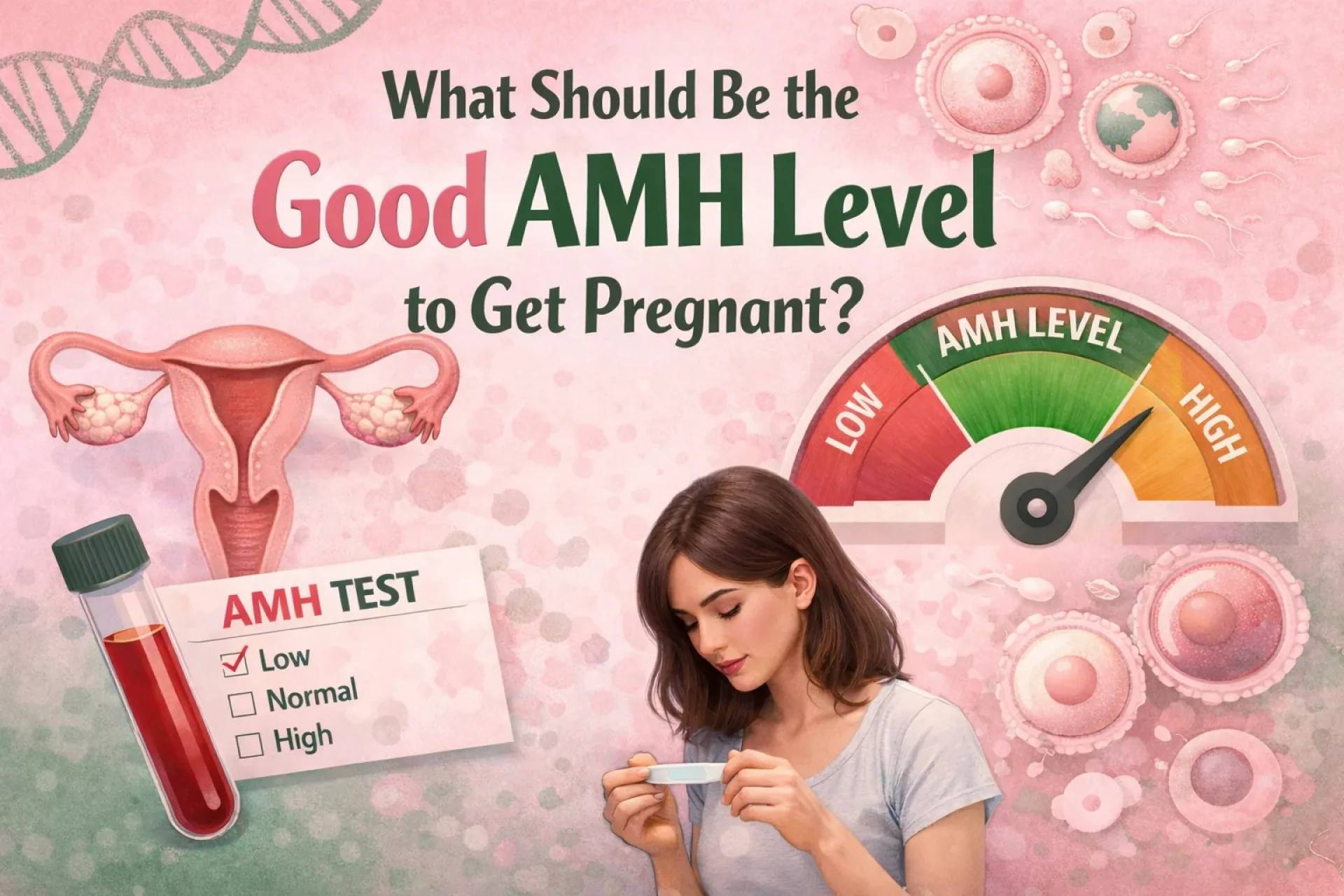
AMH levels are one of the important aspects of reproductive health. AMH indicates the number of eggs in the ovary that are yet to be released. Normal AMH ranges from 1.0 ng/ml to 4.0ng/ml, which is ideal for getting pregnant. Anything above 4.0ng/ml or lower than 1.0ng/ml indicates an underlying condition.
What is AMH?
AMH stands for Anti-Mullerian hormone, which is secreted by ovarian follicles. It is a glycoprotein hormone that is very different from other hormones because it stays stable during the menstrual cycle. So it is a reliable hormone to see how many eggs remain in the ovaries. AMH in females provides nourishment to the ovarian follicles and helps in their growth. AMH is also found in male testis, but it is of no clinical significance in males.
Also, there are other hormones that are released during the menstrual cycle, like FSH (Follicle-stimulating hormone), which helps in ovarian follicle growth, LH (Luteinizing hormone), which regulates the period and triggers the release of eggs, Estrogen, progesterone, etc., which help in the regulation of the menstrual cycle and also maintain the uterine lining.
Normal AMH levels
AMH levels are higher when you are younger and decrease with increasing age-
For 20-25 years old female, AMH levels range from 3.0ng/ml to 5.0ng/ml,
For 26-30 years it is 2.5ng/ml to 4.0ng/ml,
For 31-35 years, it ranges from 1.5ng/ml to 3.5ng/ml
For 36-40 years old female it is 1.0 to 3.0ng/ml
For 41- 45 years old female it is normally 0.5 to 2.0ng/ml, and then after that it stays less than 1.0ng/ml.
AMH levels and Fertility
Only AMH is not responsible for fertility; it is just one hormone out of many, and it only indicates the quantity of eggs, not their quality. Higher AMH suggests higher ovarian reserve, and lower AMH suggests lower ovarian reserve. Most females can still conceive naturally despite having low AMH.
Age also plays an important role in getting pregnant, even if the AMH levels are good. Women younger than 35 years of age have higher chances of getting pregnant than older women, even if their AMH levels are similar. In a study, it was found that young females who have low AMH have 65% chances of getting pregnant naturally if they experience a normal period.
For women who want to conceive, they should have AMH levels between 1.0ng/ml and 3.0ng/ml at least, because anything lower than that requires fertility treatment. For women under the age of 30 years, AMH should be 2.5 to 3.0ng/ml, and for women aged 35, it should not be lower than 1.5ng/ml to conceive naturally.
Factors that affect AMH
There are several factors that affect the levels of AMH, which include-
Age- Age is the biggest factor that affects AMH levels. AMH levels drop suddenly after the age of 35. So women are recommended to conceive before 35.
Medical procedures- Treatments like radiation therapy, chemotherapy, and ovarian surgery can significantly affect AMH.
Early menopause- People who have a family history of early menopause have AMH levels that drop below 1.0ng/ml and sometimes become undetectable, which indicates depleted or no ovarian reserve.
PCOS- It is seen in PCOS patients that AMH levels are very high, which indicates high ovarian reserve
Lifestyle- unhealthy diet, no exercise, bad sleep cycle, smoking, and alcohol consumption affect AMH levels and makes ovaries age faster than normal.
How to increase AMH?
There is no one-shot solution to increase AMH levels instantly. You can improve your diet, change your lifestyle, do yoga, and exercise to naturally boost ovarian health and increase AMH levels. You can also choose Ayurveda, because it provides natural ways to increase AMH levels by different procedures, herbs, and yoga.
Following a healthy diet- Eating protein, antioxidant-rich foods like green leafy vegetables, nuts, berries, and seeds. Healthy fat and fiber-rich diet, like fish, is best to boost fertility.
Medication and procedures- Procedures like IVF, Acupuncture, PRP (platelet-rich plasma), Androgen therapy, and donor eggs are the procedures and alternatives for AMH.
Weight management- Overweight or underweight both cause hormonal imbalance. So maintaining weight can prove useful.
Stress management- A lot of stress triggers release of cortisol, which interferes with reproductive hormones. To manage stress, yoga and breathing exercises are recommended.
Sleep- To achieve hormonal balance atleast 8 hours of sleep is necessary for the body.
Increasing AMH with Ayurveda
Ayurveda provides a holistic approach and can help with low AMH levels.
Medication- Specific herbal medicines like Shatvari, which improves ovarian function and balances hormones, Ashwagandha, which helps in managing stress, Gokshura, which is known to improve reproductive health and maintain hormonal equilibrium, and Phala ghrita, which is ghee infused with herbs to make it medicated, strengthens the uterus.
Panchkarma- This includes detoxification of the body by removing toxins (ama) and improving blood circulation in the reproductive organs, mainly the ovaries. This includes mainly Basti and Uttar basti which are types of enema used to purify the reproductive tracts and balance hormones, and Virechana, which cleanses the liver and reproductive tissue.
Lifestyle changes-In Ayurveda, too, a balanced diet, weight management, stress management, and avoiding alcohol and smoking are recommended to balance overall bodily functions.
These are not a sure shot at increasing AMH level, but they focus mainly on improving the quality of the eggs rather than quantity. Even women with low ovarian reserve can conceive naturally if the quality of their eggs is good.
AMH test
A test to determine AMH levels is done by a simple blood test. The blood test can be done anytime during the cycle, as AMH remains stable throughout the cycle, to determine the quantity of eggs yet to be released from the ovary. You should get tested only after consulting a healthcare expert and when you are facing fertility issues.
When to get tested
Fertility test- If you are having trouble getting pregnant after having unprotected intercourse for a year. If you are over 35 and want to conceive, or you just want to know your egg count.
Early menopause- If you have a family history of early menopause, then you should get your AMH levels tested, and if you want to conceive, then you should do it earlier.
IVF- If you are planning to get IVF, then doctors recommend this test to get an idea of how your ovaries are going to respond when stimulated.
Medication- After therapies like chemotherapy and radiation therapies in ovarian cancer or after ovarian surgeries, the AMH level may go down.
PCOS- In PCOS, the AMH levels are higher than usual, so if you have any symptoms of PCOS, AMH levels are tested.
The hormone levels are shown in ng/ml after the test. The AMH test only determines the quantity of eggs, not their quality. So, for further knowledge, other hormones are tested.
Conclusion
If you want to conceive, and are wondering what the best level of AMH is to get pregnant. A good AMH level ranges between 1.0ng/ml and 4.0ng/ml, which is an ideal range to conceive. AMH levels depend mostly on age, and they go down with age. The highest levels are in females under 30. AMH levels are affected by a bad lifestyle, menopause, medical procedures, and other diseases. Like in PCOS, it is higher than usual, which indicates a higher quantity but not a higher quality, which leads to irregular ovulation and infertility. AMH levels can not drastically increase, but the quality of the eggs can be enhanced by following a healthy diet, lifestyle changes, exercises, yoga, and Ayurveda’s holistic approach.
- Feb 28, 2026
- Fertility & Preconception